
5 błędów rodziców uczących jazdy na rowerze
You've watched the videos. You've bought the bike. You're in the park. Three hours later, both of you are exhausted, the child is crying, and the bike is on its side. We've been there.
Most parents fail at teaching cycling not because they're bad at teaching, but because the conventional method (run behind, hold the saddle, let go) is wrong. Here are the five mistakes — and what to do instead.
Mistake 1 — Starting with stabilisers (training wheels)
Why it fails: Stabilisers prevent the child from ever leaning. Cycling is a leaning sport. A bike that can't lean teaches the wrong reflex. When you eventually remove the stabilisers, the child has to unlearn 6+ months of "stay upright" instinct.
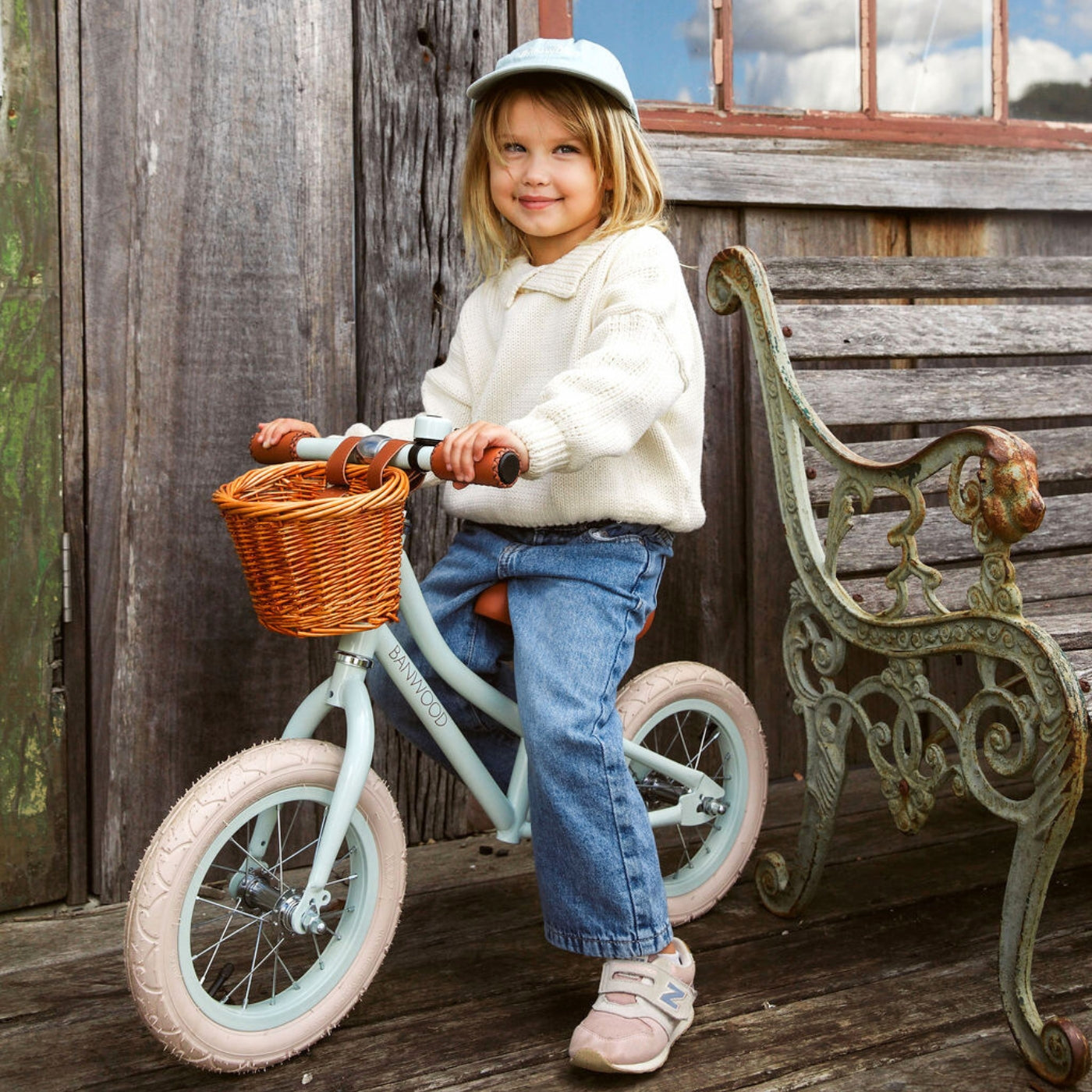
What to do instead: Start with a balance bike. Even at age 4 or 5. Even if it feels "too late." Two weeks on a balance bike will leapfrog months of stabiliser confusion.
Mistake 2 — Holding the saddle and running behind
Why it fails: When you hold the saddle, the child rides your balance, not theirs. They learn to depend on the support; the moment you let go, they fall. They never learn to feel the bike's natural balance because you're providing artificial balance.
What to do instead: Don't hold the bike at any point. Use the lowered-saddle, feet-flat method. The child propels themselves. You walk alongside, encouraging — not supporting.
Mistake 3 — Saddle too high
Why it fails: Common parent thinking: "the saddle should be high so they can pedal efficiently." Wrong for learning. A high saddle means feet can't reach the ground when balance fails. When balance fails (it will, repeatedly), the child can't catch themselves. They fall. They cry. They quit.
What to do instead: Lower the saddle so both feet are flat on the ground with knees slightly bent. Yes, this is "too low" for efficient pedaling. That's intentional. We're teaching balance and confidence first, then we'll raise the saddle 2 cm at a time over the following sessions.
Mistake 4 — Choosing a parking lot or empty road
Why it fails: Hard surfaces hurt when you fall. Smooth tarmac is also faster than learners need. The combination = scary first session = "I don't want to ride."
What to do instead: Find a slightly sloped grassy area. Grass for soft falls. Slight slope so the child can coast without pedaling. This is the single best learning environment. After 1-2 sessions on grass, transition to tarmac.
Mistake 5 — Pushing through frustration
Why it fails: A 4 year old's frustration tolerance is about 15 minutes. Cycling instruction sessions of 60+ minutes are how parents create "I hate biking" memories. The bike becomes associated with stress.
What to do instead: Sessions of 15-25 minutes max, ending while the child is still engaged. End on a small win — "you did 5 metres without putting your feet down!" Not a big finale. Several short sessions over a week beat one painful session.
The proven method (5 sessions, ~25 minutes each)
Session 1 — Sit and roll (no pedals). Saddle low. Child pushes with feet, like a balance bike. Goal: 3+ seconds of feet up.
Session 2 — Glide and steer. Same, but on slight downhill grass. Goal: 5+ second glides, casual steering.
Session 3 — Pedal walk. On flat ground. Child sits, pushes off with feet, places feet on pedals once moving. Don't worry about getting the second foot up reliably — just one rotation is success.
Session 4 — Pedal continuous. Continuous pedaling, 5-10 metres. Stops happen with feet down, not with brakes yet.
Session 5 — Brake practice. Add brake practice. Have child squeeze rear brake (right hand for most countries) while rolling slowly. Build muscle memory.
After 5 sessions, most kids are riding. Some take 3 sessions. Some take 8. All work, if you don't introduce the 5 mistakes above.
What to do when the child says "I can't"
A 4-6 year old saying "I can't" usually means "I'm scared right now." It rarely means "I lack the physical skill."
Three responses that work:
- "OK. Let's stop now and try tomorrow." (Removes pressure.)
- "Let's just sit on the bike and talk. No riding." (Lowers stakes, often leads to riding 5 minutes later.)
- "What part feels scary?" (Information. Sometimes it's a real bike fit issue you missed.)
Three responses that don't work: "Don't be scared." "Other kids your age do this." "Just try harder."
Read next
Free EU shipping over €100 · 14-day returns · 2-year warranty.
